Gemz guide · Gems
The Gemz gem guide
Gems decide how big your scores get. There are 42 of them across eight rarities: 34 you can find in jewel boxes and 8 meteorites that only fall during the monthly Meteor Shower. This page explains what each stat does, how your whole collection adds up, how to level a gem up, and where every gem comes from.
What a gem does
Open a gem in the Collection and its card shows three stats:
- Power is added to the Power of your mix when the gem is equipped. The Power of your mix is the starting point of every scoring move in your games, whatever gems the move clears.
- Multiplier is added to the MULT of every move that clears the gem. Clearing three gems at ×5 adds 15 to the move's MULT.
- Appearance rate is how often the gem shows up in your pieces compared with the other gems of your mix.
On top of that, clearing identical gems together triggers synergy: +4 for two, +9 for three, +16 for four, counted in average gems of your mix. The full formula, with a worked example, is in How to play. Tap a gem to see it in 3D: you can turn it with your finger, and it opens at the same angle and colour as its picture on the board.
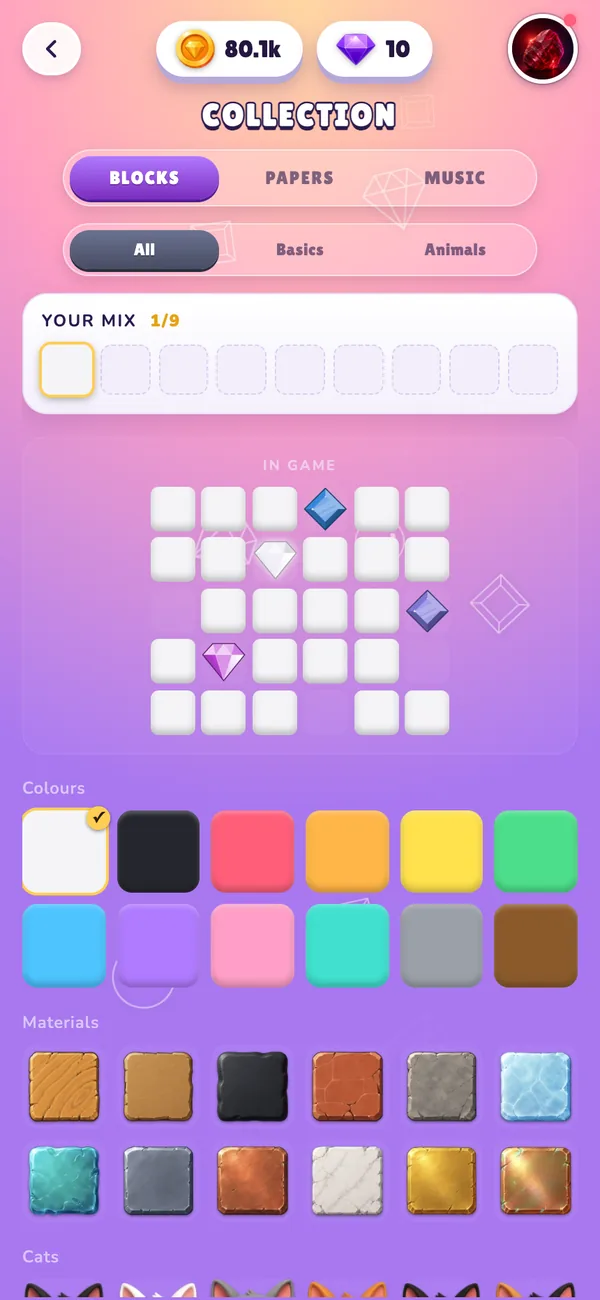
Your whole collection counts
Since version 1.0.9, your Power is not only your mix: it is multiplied by a collection bonus. Every different gem you own adds 4.5%, and every level gained by any of your gems adds 1%, compounding, even for a common gem that never leaves the Collection. A player who owns all 34 boxed gems at level 10 multiplies every move by about 41.
That makes every level up useful. The cheapest level ups, on gems you no longer equip, still raise the Power of every game you play. The gem card says what one more level brings to the whole collection.
The eight rarities
Rarer gems arrive at a higher level, with far bigger stats, but they appear less often on the board. A gem's Power doubles with each level up to level 7, then grows by half at each of levels 8, 9 and 10. The table gives each rarity's starting level, then its Power and Multiplier at that level and at the maximum level, 10.
| Rarity (gems) | Start | Power | Multiplier |
|---|---|---|---|
| Common (8) | Lv 1 | 10 → 2,160 | ×2 → ×10 |
| Uncommon (6) | Lv 2 | 150 → 16,200 | ×3 → ×11 |
| Rare (5) | Lv 3 | 1,800 → 97,200 | ×5 → ×12 |
| Epic (4) | Lv 4 | 62,000 → 1.67 million | ×9 → ×17 |
| Legendary (4) | Lv 5 | 380,000 → 5.13 million | ×16 → ×27 |
| Exotic (4) | Lv 6 | 6.1 million → 41.2 million | ×27 → ×40 |
| Mythic (3) | Lv 7 | 540 million → 1.82 billion | ×45 → ×59 |
| Meteorite (8) | Lv 8 | Each meteorite has its own profile (see below) | |
Uncommon gems are labelled Atypical on some screens. Appearance rates follow rarity: commons are by far the most frequent, and mythics and meteorites the rarest. A gem's appearance rate goes up at level 5 and again at level 10.
Gem values can be rebalanced in updates. The card of each gem in your Collection always shows its exact current Power, Multiplier and appearance rate.
Copies, coins and gem levels
Your first copy of a gem unlocks it at its starting level. From there, each level up costs copies of that same gem plus coins, and the copies are used up when you level up. The maximum level is 10. When a gem has enough copies to level up, the Collection flags it.
Here is the full path of a common gem, which starts at level 1:
| New level | Copies needed | Coins |
|---|---|---|
| 2 | 2 | 100 |
| 3 | 5 | 200 |
| 4 | 10 | 500 |
| 5 | 20 | 1,000 |
| 6 | 50 | 2,000 |
| 7 | 100 | 5,000 |
| 8 | 200 | 10,000 |
| 9 | 500 | 20,000 |
| 10 | 1,000 | 50,000 |
Every rarity follows the same sequence of copies (2, 5, 10, 20, 50 and so on), counted from its own starting level. A legendary, which starts at level 5, needs 2 copies for level 6, then 5, 10 and 20, and 50 for level 10. A mythic only has three levels to climb: 2, 5 and 10 copies. The coin cost, on the other hand, depends only on the level you are going to, whatever the rarity.
Taking a common gem all the way to level 10 costs 1,887 copies and 88,800 coins; a legendary needs 87 copies and 87,000 coins. As a gem levels up, its look changes too: rough at levels 1 to 3, polished from 4 to 6 and faceted from level 7. Rarer gems arrive already polished or faceted.
Jewel boxes
Jewel boxes, also called chests, are the main source of gem copies. You earn them as level rewards on the ladder (85 of the 200 levels give one), in the weekly tournament, in the Champion's League and on the Events page. The shop sells Common to Exotic boxes for jewels, and its free daily gift is sometimes a box.
Opening a box
A new box goes into one of your box slots. Tap Start to launch its timer, which depends on its rarity; only one box can count down at a time.
| Box | Opening time |
|---|---|
| Common | 10 minutes |
| Uncommon | 25 minutes |
| Rare | 1 hour |
| Epic | 3 hours |
| Legendary | 8 hours |
| Exotic | 12 hours |
| Mythic | 16 hours |
You start with two box slots and can unlock two more with jewels. To go faster, watch an ad to take 30 minutes off a timer, up to five times per box, or spend jewels to open it right away. If all your slots are full when you win a new box, you can open one to make room, unlock a slot, or sell the new box for coins.
What's inside
Apart from the Coins box, which holds only coins, every box gives coins and copies of several gems, up to its own rarity, with a chance of a gem one rarity higher. A Mythic box always contains a Mythic gem. Boxes never give a gem your rank hasn't unlocked yet; you get the best rarity you can hold instead. From Uncommon boxes up, there is also a small chance of a cosmetic item such as a block style, wallpaper or music track; if you already own every cosmetic of the rarity it rolls, you get jewels instead.
When a box opens, a gem sometimes turns into a choice: you pick between that gem and another of the same rarity, usually one you don't own yet. Choices come up more often for rarer gems, and the Choice box turns every gem it gives into a choice. The exact drop rates of every box are listed in the game's shop.
Every gem, and when it unlocks
New gems start appearing in jewel boxes as your rank goes up. The Collection shows the ones you can already find and, with a padlock, those waiting for a higher rank.
| Rarity | Gems (rank at which they enter boxes) |
|---|---|
| Common | Rock Crystal, Rose Quartz, Amethyst, Citrine (Wood) · Tiger's Eye, Nephrite Jade (Bronze) · Obsidian, Carnelian (Silver) |
| Uncommon | Turquoise (Wood) · Peridot (Bronze) · Yellow Topaz (Silver) · Lapis Lazuli, Moonstone (Gold) · Malachite (Platinum) |
| Rare | Almandine Garnet (Bronze) · Aquamarine (Silver) · Rubellite, Amber (Gold) · Blue Zircon (Platinum) |
| Epic | Tanzanite (Silver) · Alexandrite (Gold) · Black Opal, Tahitian Pearl (Platinum) |
| Legendary | Ruby (Gold) · Sapphire, Emerald (Platinum) · Diamond (Diamond) |
| Exotic | Paraíba Tourmaline (Platinum) · Red Diamond, Blue Diamond, Pink Diamond (Diamond) |
| Mythic | Rainbow Diamond, Orichalcum, Philosopher's Stone (Diamond) |
Meteorites
The eight meteorites never come from jewel boxes. They fall onto the board, sealed in a crust, during the Meteor Shower, the event held on the fourth weekend of every month in the iOS and Android apps. Once cracked open, a meteorite joins its own section at the end of your Collection, starts at level 8, and can be equipped and levelled up like any other gem. It also counts toward your collection bonus. Each meteorite has a profile that shapes its stats:
- Worker (Moldavite, Libyan Glass): slightly lower Power and Multiplier, but it shows up more often, and more so as it levels.
- Balanced (Allende Chondrite): the reference profile, with no strong side.
- Cannon (Pallasite, Martian Meteorite): a higher Multiplier and less Power, and it appears less often.
- Titan (Gibeon, Sikhote-Alin): the most Power of any gem and a lower Multiplier, and it appears less often.
- Phantom (Lunar Meteorite): the highest Multiplier in the game, but the least Power and the lowest appearance rate, which levelling barely changes.
Choosing gems for your mix
The Power shown above your gem slots is your mix's Power multiplied by your collection bonus: the starting point of every move in your next game. Strong gems raise it a lot, so your best gems belong in the mix. The Multipliers of the gems you clear, and how often identical gems meet on the board, then decide the MULT. A mix with fewer kinds of gems makes identical-gem clears more frequent, within the limit of identical gems the level allows. The Auto mix button on the level screen picks a strong mix for you, and the strategy tips go further.